How is food waste recycled? 

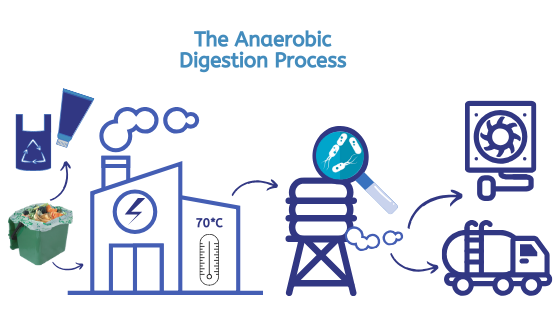
In Devon all our food waste gets sent to be anaerobically digested, hover over the process diagram to discover what happens to your food waste. 

Food waste is not only recycled by anaerobic digestion, it can also be composted! To learn more about compost, click here. 

In 2024 to 2025, 26,827 tonnes of food waste were collected from Devon’s households to be sent to anaerobic digesters that’s the weight of over four thousand adult male African elephants (IERE, 2025) Which is amazing! Yet almost a third of what we throw away is still food waste, which is another 35 thousand tonnes. Imagine how much more food we could recycle! (Devon County Council, 2025) 

For more information on how to use your food waste collection, check out our sister page Recycle Devon – Using your food waste collection.
1
2
3
4
5
6
Diagram of the Anaerobic digestion process from food waste to methane
1

Food waste is collected from your doorstep in caddies and taken by truck to an anaerobic digestion plant.

2

Packaging such as caddy bags and bread bags is removed by a mechanical process.

3

Food waste is turned into a soup and heated to 70 degrees to kill any unwanted bacteria.

4

Helpful methanogenic bacteria are introduced to the food waste soup.

5

The methane produced as a waste gas by the bacteria is removed and burnt to power a turbine, which produces electricity.

6

The process leaves a nutrient rich substance which farmers spread on land as a soil improver.

Why is recycling Food Waste important? 

  • Creating renewable energy – anaerobic digestion is one way of recycling food waste and makes fertiliser, electricity and heat. It is also energy efficient as 50,000 tonnes of food waste can power 7000 homes. 1Kg of food waste charges a smartphone for 79 hours! 
  • Saving resources – it takes a huge amount of energy and water to grow food and even more resources such as fuel to transport the food to supermarkets across the country. Throwing away food means that we have wasted all of this effort and resources. 

How to Recycle Food Waste at School

In schools the main culprits of food waste are school dinners and packed lunches. Our Zero Waste Lunch pages could help your school develop a zero waste culture around lunchtime waste. See our Case Studies pages for some examples of schools who have tried out some of the ideas here.

Other things to consider could be a compost heap in school grounds for any breaktime fruit waste and things like coffee grounds and teabags from staffrooms.

100 schools in Devon took part in our long running Schools Composting project, which ran from 2008 to 2012. Schools were provided with composting equipment which could deal with cooked and uncooked food waste in school grounds. Read more about School Composting in our Guide to School Composting.

Are you still using equipment or is it sitting around somewhere. We might be able to help relocate it! Contact us!

Composting in School: A practical guide to composting food waste

This guide has been written for schools interested in composting their cooked food waste as well as cores and peels.

It explains the different types of composting equipment available; explores issues to consider before you purchase your composter; explains how to achieve the all-important balance of materials for successful composting; and suggests ways to involve the whole school in this ground-breaking form of composting.

Composting in Schools: A practical guide to composting food waste

Troubleshooting sheet for composting raw food waste

Troubleshooting sheet for cooked food waste using a turning composter

Zone © 2026 Recycle Devon